
Pros
- No expiry date allows indefinite position holding without rollover costs
- Funding rate mechanism actively anchors price to spot market
- Cash settlement eliminates need for wallet management or asset custody
- High leverage availability amplifies capital efficiency for experienced traders
- 24/7 trading on crypto-native exchanges unlike traditional futures markets
Cons
- Funding rate payments can silently erode profits during extended holds
- High leverage dramatically accelerates liquidation risk for directional wrong bets
- Regulatory uncertainty varies sharply by jurisdiction with some exchanges restricting access
- Complex mechanics (mark price, insurance funds, auto-deleveraging) create hidden failure modes
Claim Exclusive Trading Bonuses
- 0% maker fees on top exchanges
- Up to 400x leverage
- No-KYC required
- Exclusive sign-up bonuses
Trusted by pro traders securing VIP fee tiers via Trading365
Quick Answer
Perpetual futures are cryptocurrency derivatives with no expiry date that let you bet on price direction with leverage, staying open indefinitely until you close the position or get liquidated.
What They Actually Are
Standard futures contracts obligate buyers and sellers to transact an asset at a set price on a specific future date. Perpetual futures strip away that expiry date. First introduced by BitMEX in 2016, these instruments now dominate crypto derivatives trading.
The key distinction: you never take delivery of Bitcoin, Ethereum, or any underlying asset. The contract simply tracks the spot price through a mechanism called the funding rate. Profits and losses settle in cash—typically stablecoins like USDT or USDC, sometimes the native crypto itself. You gain price exposure without wallet addresses, private keys, or blockchain interactions.
Unlike traditional futures where convergence to spot price happens automatically at expiry, perpetuals need an active mechanism to prevent the contract price from drifting far from the underlying market. That mechanism is where most traders win or lose silently.
How the Mechanics Work
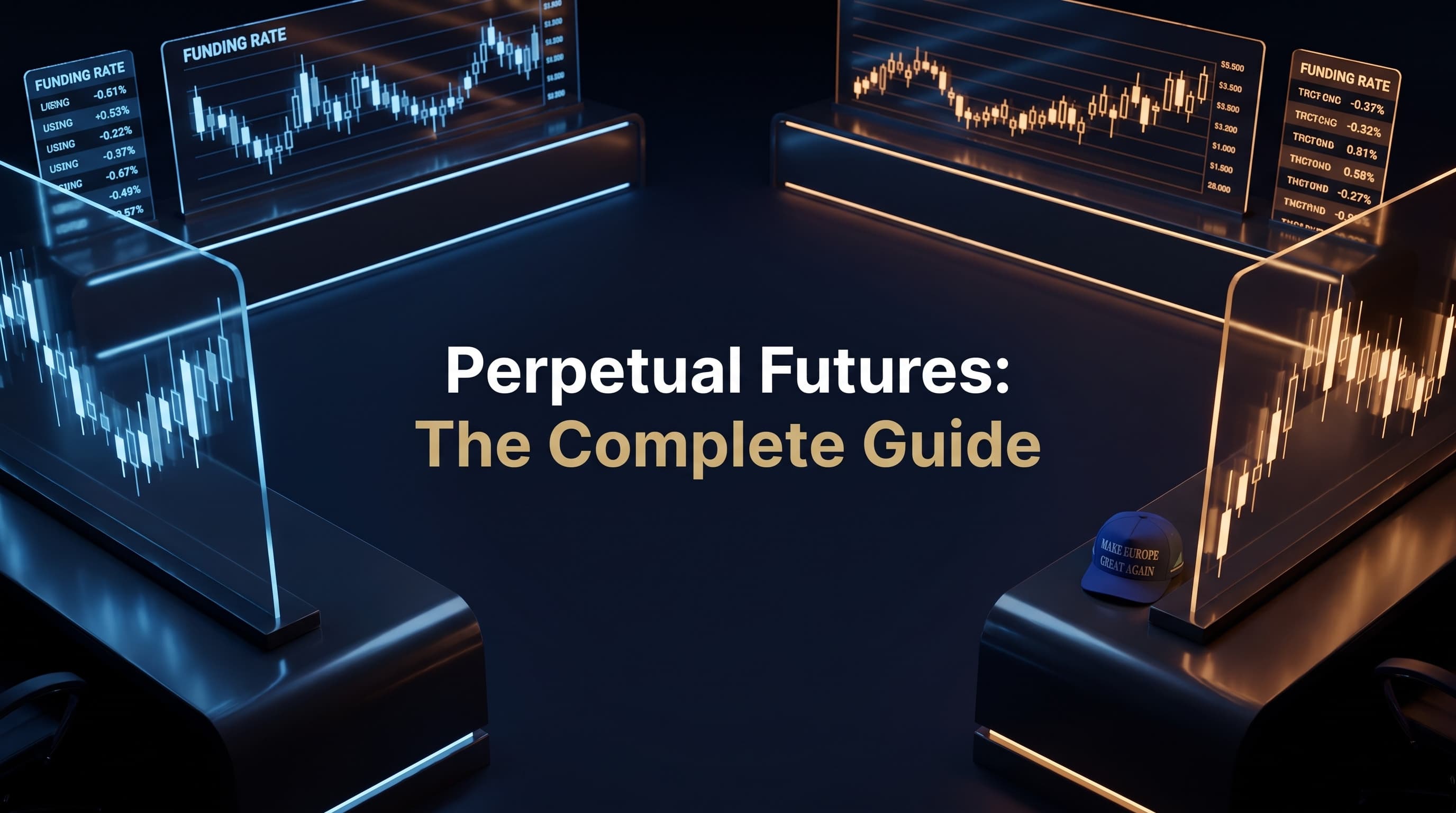
Funding Rate
The funding rate is a periodic payment exchanged between long and short position holders. It exists solely to tether the perpetual contract price to the spot market.
- Positive funding rate: The perpetual trades above spot. Longs pay shorts.
- Negative funding rate: The perpetual trades below spot. Shorts pay longs.
Payments typically occur every eight hours on major exchanges, though some platforms use one-hour or even continuous intervals. The rate itself derives from two components: an interest rate (usually minimal, reflecting the cost of holding cash versus crypto) and a premium index measuring how far the perpetual deviates from spot.
Binance's documentation explains that funding rates use time-weighted average prices to reduce manipulation vulnerability. During extreme volatility, these rates can spike dramatically—sometimes exceeding 0.1% per eight-hour period, which compounds to over 100% annualized if sustained.
Margin and Leverage
To open a position, you post collateral called margin. Exchanges offer leverage ratios from 2x to 100x or higher depending on the asset and platform. With 10x leverage, a $1,000 position requires $100 in margin.
Two margin modes exist:
- Isolated margin: Risk limited to the specific margin allocated to that position
- Cross margin: Your entire account balance backs all positions, reducing liquidation risk for individual trades but exposing your full balance
Mark Price vs. Last Price
Exchanges calculate liquidations using a "mark price"—an averaged, manipulation-resistant reference—rather than the raw last traded price. Bybit's documentationVerified notes this protects traders from being liquidated by single wicks or thin-order-book spikes. The mark price typically incorporates spot index prices and moving averages of the perpetual's own trading.
Liquidation
If losses approach your margin balance, the exchange automatically closes your position. You lose your posted collateral. With high leverage, a small adverse move suffices. At 50x leverage, a 2% price move against you triggers liquidation (minus maintenance margin requirements).
Analogy: Imagine betting on a horse race that never finishes. Instead of waiting for the final payout, you and your opponent settle small payments every few hours based on who's currently ahead. The track itself—through the funding mechanism—forces these settlements to keep the betting odds aligned with the horse's actual performance.
Where They're Actually Used
Hedging
Miners with predictable Bitcoin production costs, or whales with large holdings, use perpetuals to lock in prices without triggering taxable events or moving coins. A miner expecting 10 BTC monthly can short 10 BTC worth of perpetuals, neutralizing price risk while keeping the actual Bitcoin.
Leveraged Speculation
The most common use case. Traders deploy small capital for multiplied exposure. A $500 account at 20x leverage controls $10,000 in Bitcoin exposure. This cuts both ways—gains and losses amplify equally.
Arbitrage
Sophisticated traders exploit funding rate differentials across exchanges, or between perpetuals and spot markets. When Binance funding runs +0.05% and Bybit runs -0.01%, traders short the expensive, long the cheap, capturing the spread. Basis trading—buying spot, shorting perpetual when funding is strongly positive—extracts funding payments with theoretically neutral price exposure.
Stop the Fee Drain
High-volume traders are losing ~$2,000/mo on taker fees. Zero-fee structures exist — most traders just don't know how to access them.
Start Saving NowShorting
Perpetuals provide straightforward short exposure even in assets with thin or expensive borrow markets. No need to locate and pay borrow fees on actual coins.
Key Trade-Offs & Risks
| Upside | Downside |
|---|---|
| No expiry/rollover costs | Funding fees erode profits over time |
| Easy short exposure | Liquidation risk amplified by leverage |
| Deep liquidity on major pairs | Exchange counterparty risk (no SIPC protection) |
| Capital efficiency | Extreme volatility can wipe position before you react |
Hidden Costs
Funding rates transform "hold and wait" into a bleeding strategy when you're on the wrong side. A long position in persistently positive funding—common during bull markets—bleeds predictable percentage points daily. Traders sometimes enter positions funding-neutral or funding-positive, letting the rate work for them rather than against.
Counterparty and Structural Risk
Crypto exchanges lack the regulatory protections of traditional brokerage. No SIPC insurance, no FDIC backing. The U.S. Commodity Futures Trading Commission has repeatedly warned about unregulated offshore platforms offering extreme leverage. Exchange failures, hacks, or withdrawal freezes can strand capital regardless of trading acumen.
Socialized Losses and Insurance Funds
During mass liquidation cascades—when prices move rapidly and leveraged positions cascade into forced selling—exchanges face solvency risk. Most major platforms maintain insurance funds, built from liquidation fees, to absorb losses. If these deplete, some exchanges historically "socialized" losses across profitable traders, though this practice has grown rare on tier-one platforms. BitMEX's insurance fund documentation details how this mechanism operates.
Common Misconceptions
"No expiry means no cost"
Funding rates represent continuous cost. In sustained directional markets, these often exceed the quarterly rollover costs of dated futures. Active traders compare all-in costs across instrument types.
"I own the crypto"
You hold a derivative contract with zero blockchain rights. No staking yields, no airdrops, no governance participation, no ability to transfer to self-custody. Your "Bitcoin" position exists only as a database entry at your exchange.
"Liquidation = stop-loss"
Liquidation is forced, involuntary, and often executes at worse-than-expected prices during volatility. Stop-loss orders attempt to close positions at specified levels but may slip dramatically in fast markets. Liquidation guarantees maximum loss—your full margin—while a stop-loss might preserve some capital if it executes near target.
Bottom Line
Perpetual futures are powerful tools for price exposure, hedging, and sophisticated trading strategies. The funding rate mechanism elegantly solves the no-expiry problem, but introduces its own cost structure that rewards active management and punishes passive holding. Leverage amplifies both capability and danger.
Match this instrument to specific, active trading objectives or precise risk management needs—not to long-term investment conviction. The trader who understands funding mechanics, monitors margin levels obsessively, and respects liquidation risk gains genuine utility. The trader who treats perpetuals like spot ownership with extra juice typically becomes the funding source for everyone else.
Ready to Act on the Research?
- 0% maker fees on top exchanges
- Up to 400x leverage
- No-KYC required
- Exclusive sign-up bonuses
Trusted by pro traders securing VIP fee tiers via Trading365
Frequently Asked Questions
What happens if I hold a perpetual futures position for weeks?+
Your position stays open indefinitely, but you'll pay or receive funding rates every 8 hours (or your exchange's interval). A consistently positive rate while long will slowly drain your margin—this is why funding rates matter more than entry price for long-term holds.
How is perpetual futures liquidation different from margin calls?+
Crypto exchanges use a 'mark price' (spot index) rather than last traded price to trigger liquidations, preventing manipulation. Once your maintenance margin is breached, the position closes automatically via the insurance fund or auto-deleveraging system—no broker calls, no time to add collateral.
Why would I choose perpetual futures over spot trading?+
Perpetuals offer leverage up to 100x or more, letting you control larger positions with less capital. You also gain short exposure without borrowing assets. However, you sacrifice ownership (no actual crypto in your wallet) and introduce funding costs and liquidation risk.
Can funding rates predict market direction?+
Extreme funding rates often signal crowded positioning. Very high positive rates suggest excessive leverage on the long side, historically preceding corrections. Some traders use funding rate heatmaps as contrarian indicators, though this is a probabilistic edge, not a guarantee.
Which exchanges have the lowest perpetual futures fees?+
Fee structures vary by maker/taker model and VIP tiers. Binance, Bybit, and dYdX compete closely on base rates, but funding rate intervals and premium index calculations differ—check your specific trading frequency and size, as these 'hidden' costs often exceed explicit fees.
Are perpetual futures legal in the United States?+
US residents face significant restrictions. Major offshore platforms block US IP addresses, and regulated US alternatives like CME offer Bitcoin/ether futures with traditional expiry structures—not true perpetuals. State-level regulations add further complexity for accessible platforms.
Related Articles
How to Read an Order Book: A Beginner's Guide to Crypto Market Depth
Reading an order book lets you see exactly where supply and demand meet in real time. You'll learn to interpret bid and ask prices, calculate the spread, and as
Best Crypto Exchange for Day Trading: Top Platforms Ranked for Speed, Fees & Liquidity
Day trading crypto demands tight spreads, fast execution, and reliable uptime—small inefficiencies compound into significant costs across hundreds of trades. Th
How to Withdraw From Binance: A Step-by-Step Guide for Crypto and Fiat
This guide shows you how to withdraw cryptocurrency or fiat currency from your Binance account to an external wallet, bank account, or another exchange. Crypto
💰 Stop Donating Profits to Exchanges
You've seen the math. High-volume traders save $2,000+ monthly just by choosing the right partner tiers. We've pre-negotiated exclusive bonuses, maker rebates, and VIP fast-tracks across the top 2026 exchanges.