
Pros
- Explains mechanical cause of violent crypto crashes
- Highlights importance of maintenance margin awareness
- Demonstrates why high leverage increases cascade risk
- Shows how thin liquidity amplifies price dislocations
- Reveals predictable patterns traders can monitor
Cons
- No specific exchange margin requirements provided
- Lacks historical cascade examples with actual price data
- No risk mitigation strategies for traders
- Does not cover insurance funds or socialized loss mechanisms
Claim Exclusive Trading Bonuses
- 0% maker fees on top exchanges
- Up to 400x leverage
- No-KYC required
- Exclusive sign-up bonuses
Trusted by pro traders securing VIP fee tiers via Trading365
---
Liquidation Cascade Explained
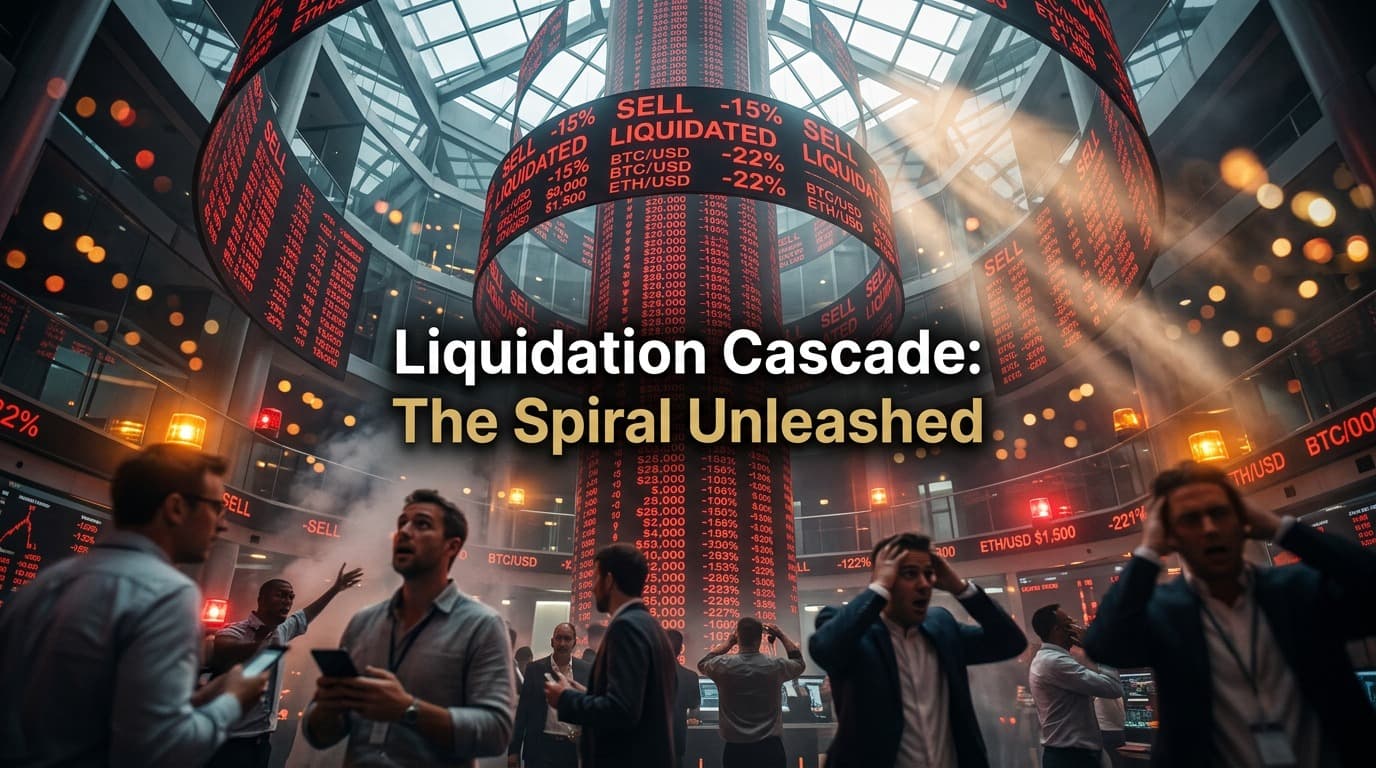
A liquidation cascade is a chain reaction where forced selling of leveraged positions pushes prices lower, triggering more liquidations in a self-reinforcing spiral. These events are common in crypto markets where high leverage and 24/7 trading create conditions for rapid, violent price moves.
---
What It Is
Liquidation cascades occur in leveraged markets—primarily futures, perpetual swaps, and margin trading—where traders borrow funds to amplify their positions. When prices move against these traders, their collateral (margin) erodes. Once margin falls below a maintenance threshold, exchanges automatically close positions to protect lenders and the platform.
Each forced closure executes as a market order, adding immediate sell pressure (for long liquidations) or buy pressure (for short liquidations). This pushes prices further, potentially breaching the next cluster of liquidation prices, and the cycle continues.
Key characteristics:
- Mechanical, not discretionary — liquidations execute automatically based on preset rules
- Self-amplifying — each liquidation feeds the next
- Concentrated in high-leverage environments — more leverage means tighter liquidation clusters
- Liquidity-dependent — thin order books allow larger price dislocations
---
How It Works
The Setup
Traders open leveraged positions by posting collateral. A trader with $1,000 might use 10x leverage to control $10,000 worth of Bitcoin. Their liquidation price sits relatively close to their entry—perhaps 9-10% below for a long position, depending on the exchange's maintenance margin requirement.
The Trigger
An adverse price move—perhaps sparked by a macro announcement, whale sale, or technical breakdown—erodes the position's margin. When unrealized losses approach the collateral value, the exchange issues a margin call. If unfilled, automatic liquidation follows.
The Cascade
| Stage | What Happens | Market Impact |
|---|---|---|
| 1. Initial liquidation | Position closed at market | Small price push |
| 2. Threshold breach | Price hits next liquidation cluster | Multiple positions close simultaneously |
| 3. Acceleration | Selling overwhelms buy orders | Sharp, non-linear price drop |
| 4. Capitulation or absorption | Leverage flushed or buyers step in | Cascade exhausts, potential reversal |
Analogy: Picture dominoes spaced inches apart. Toppling the first knocks the next before anyone can intervene. In markets, "intervention" means placing buy orders—but in thin liquidity, those orders sit too far below to catch the falling price quickly.
---
Where It Happens & Why It Matters
Primary Venues
Crypto perpetual futures dominate liquidation cascade frequency and severity. Major platforms include centralized exchanges like Binance, Bybit, and OKX, plus decentralized protocols like dYdX and GMX. The Bitcoin futures market on CME sees cascades too, though typically less extreme due to lower maximum leverage and circuit breakers.
Contributing Conditions
- High open interest with concentrated leverage — when many traders cluster at similar liquidation prices, the tinder is laid
- Funding rate extremes — persistently positive funding (longs paying shorts) signals crowded long positioning, increasing cascade risk if sentiment shifts, as noted in research from the Federal Reserve Bank of New York
- Fragmented price discovery — crypto trades across dozens of venues without unified tape, allowing dislocations to propagate
- Thin order books — especially weekends or holidays when traditional market makers step back
Real-World Significance
Liquidation cascades matter beyond immediate losses. They:
- Create local price extremes — cascades often mark capitulation points where selling exhausts
- Generate systemic risk — DeFi protocols with cascading collateral requirements face potential insolvency
- Damage market structure — repeated severe cascades drive participants toward lower leverage or away entirely
The Bank for International Settlements has documented how leverage amplification in crypto markets creates procyclical dynamics similar to traditional financial crises, though compressed into hours rather than months.
---
Key Things to Know
For Traders
| Practice | Rationale |
|---|---|
| Use lower leverage | Wider liquidation buffer reduces cascade inclusion risk |
| Avoid obvious liquidation clusters | Heatmaps show where crowds concentrate; standing apart helps |
| Set stop-losses with slippage awareness | In fast cascades, execution prices may gap far below stops |
| Maintain reserve collateral | Partial deleveraging before liquidation beats full closure |
For Market Observers
| Indicator | What It Signals |
|---|---|
| Liquidation heatmaps | Visual concentration of likely liquidation prices |
| Open interest relative to spot volume | Elevated ratios suggest leverage buildup |
| Funding rates | Extreme readings indicate crowded, vulnerable positioning |
| Exchange insurance fund drawdowns | Confirms cascade severity |
Benefits and Trade-Offs
Leverage exists because it serves legitimate functions: capital efficiency, hedging, and price discovery. The trade-off is systemic fragility. High leverage concentrates liquidation risk, making markets more vulnerable to feedback loops.
Key risk: Cascades can overshoot fundamental value dramatically. A token with unchanged underlying prospects may drop 30% in minutes purely due to mechanical selling. This creates potential opportunities for prepared buyers—but catching falling knives requires precise timing and risk tolerance.
---
Common Misconceptions
"Liquidations cause the initial move."
Usually false. Cascades *accelerate* existing trends rather than originate them. Some catalyst—news, whale flow, technical breakdown—starts the move. Liquidations then magnify it. Attributing causality solely to liquidations confuses amplification with initiation.
Stop the Fee Drain
High-volume traders are losing ~$2,000/mo on taker fees. Zero-fee structures exist — most traders just don't know how to access them.
Start Saving Now"Exchanges hunt stops."
Mechanically implausible at scale. Exchanges operate insurance funds that absorb losses from bankrupt liquidations—cascades deplete these funds. Platform incentives align against manufactured cascades. Price manipulation by individual actors differs from exchange-level "hunting."
"Only longs get liquidated."
Demonstrably false. Short squeezes—upward liquidation cascades—are equally violent and often faster, as short sellers face theoretically unlimited losses and may rush to cover. Bitcoin's April 2021 move and numerous altcoin pumps illustrate short cascade dynamics.
---
Bottom Line
Liquidation cascades are structural features of leveraged markets, not design flaws. They emerge predictably from the interaction of borrowed capital, automatic risk controls, and finite liquidity. Understanding where liquidation clusters form—and how thin order books amplify mechanical selling—helps traders survive these events and observers interpret their significance. In crypto's high-leverage environment, respecting cascade dynamics is essential to navigating markets that can reprice 20% or more in hours based on forced flows rather than fundamentals.
Ready to Act on the Research?
- 0% maker fees on top exchanges
- Up to 400x leverage
- No-KYC required
- Exclusive sign-up bonuses
Trusted by pro traders securing VIP fee tiers via Trading365
Frequently Asked Questions
What triggers a liquidation cascade in crypto?+
A liquidation cascade starts when an adverse price move—such as a macro announcement, whale sale, or technical breakdown—pushes leveraged positions toward their liquidation prices. Once the first cluster of positions is automatically closed, the resulting sell pressure pushes prices lower, triggering the next wave of liquidations in a self-reinforcing spiral.
Why are liquidation cascades worse in crypto than traditional markets?+
Crypto markets combine three risk factors: extreme leverage ratios often unavailable in traditional finance, 24/7 trading with no circuit breakers or cooling-off periods, and relatively thin order books that allow large price dislocations from forced market orders.
How much leverage is too much for avoiding liquidation cascades?+
The article uses 10x leverage as an example, where a long position faces liquidation roughly 9-10% below entry. Higher leverage compresses this buffer further—20x leverage roughly halves it—creating tighter liquidation clusters that cascade more easily. Lower leverage widens the margin of safety and reduces cascade participation.
Can traders predict when a liquidation cascade is likely?+
Traders can monitor liquidation cluster data, funding rates, and open interest levels to identify crowded leverage positions. However, the exact timing depends on unpredictable triggers. The article emphasizes that liquidations are mechanical and self-amplifying, making the cascade phase fast and difficult to front-run precisely.
What's the difference between long and short liquidations in a cascade?+
Long liquidations execute as market sell orders, adding downward price pressure and potentially triggering more long liquidations. Short liquidations execute as market buy orders, adding upward pressure. The article focuses primarily on long liquidation cascades, which produce the violent downside moves most commonly associated with crypto crashes.
Do all exchanges handle liquidations the same way?+
The article does not specify exchange-by-exchange differences in maintenance margin requirements or liquidation engines. However, it notes that liquidation prices depend on each exchange's specific maintenance margin rules, meaning the same position could face liquidation at different prices across platforms.
Related Articles
Best Crypto Exchange Brazil: Top Platforms Compared
Brazil's crypto market has matured rapidly, with clear regulatory frameworks from the Central Bank (Bacen) and Securities Commission (CVM) making it easier than
What Is Prop Funding in Crypto? How It Works, Risks & Red Flags
A crypto prop firm is a company that sells trading challenges: traders pay upfront fees to prove their skills on simulated accounts, with a small percentage receiving profit-sharing "funded"…

How to Read an Order Book: A Beginner's Guide to Crypto Market Depth
Reading an order book lets you see exactly where supply and demand meet in real time. You'll learn to interpret bid and ask prices, calculate the spread, and as
💰 Stop Donating Profits to Exchanges
You've seen the math. High-volume traders save $2,000+ monthly just by choosing the right partner tiers. We've pre-negotiated exclusive bonuses, maker rebates, and VIP fast-tracks across the top 2026 exchanges.