
Pros
- Covers the complete execution stack — signal detection, AI processing, broker API routing, and bot execution — in one place rather than stopping at signal detection like competing content
- Short-side arbitrage logic is treated as a first-class component from the start, not added as an afterthought, addressing where most traders are actively losing money
- Directly addresses the sub-500ms execution reality of 2026, making manual confirmation workflows obsolete and explaining why automated parameterized stacks now dominate
- Integrates with the Trading365 Short Scanner as a live detection layer, giving traders a concrete starting point rather than abstract theory
- Targeted at algorithmic traders, DeFi arbitrageurs, and quant desks — no time wasted on introductory filler for audiences that already know the basics
Cons
- Content assumes significant prior knowledge of arbitrage mechanics — traders without a quant or algorithmic background will likely struggle to implement the stack described
- The recommended detection layer routes to a specific third-party tool (Trading365 Short Scanner), creating a dependency that may not suit traders who already have a preferred scanner
- No disclosed fee structures, leverage parameters, or broker-specific API latency benchmarks are presented, making direct cost comparisons with competing stacks difficult
- The 2026 framing means portions of the execution logic may date quickly as block speeds, MEV bot behavior, and AI layer capabilities continue to evolve
Claim Exclusive Trading Bonuses
- 0% maker fees on top exchanges
- Up to 400x leverage
- No-KYC required
- Exclusive sign-up bonuses
Trusted by pro traders securing VIP fee tiers via Trading365
Verdict
AI bot + broker API + on-chain scanner is the only stack closing short-side arbitrage gaps in 2026. Signal detection without execution logic is dead weight — and 95% of competing content stops at signal detection, ignores short-side entirely, and leaves traders holding a scanner with no clear path to execution. This article covers the full stack: detection, AI processing, broker API routing, and bot execution, with short-side logic built in from the start, not added as a footnote. The detection layer everything else depends on is the Trading365 Short Scanner — start there, then build upward.
---
Quick Facts
| Field | Details |
|---|---|
| Content Focus | Full on-chain arbitrage execution stack |
| Target Audience | Algorithmic traders, DeFi arbitrageurs, quant desks |
| Strategy Covered | Short-side arbitrage (first-class, not footnote) |
| Execution Window Referenced | Sub-500ms (2026 viable threshold) |
| Core Tool Referenced | Trading365 Short Scanner |
| Stack Components | On-chain detection, AI processing, broker API routing, bot execution |
| Year Context | 2026 — post-MEV maturation, compressed block speeds |
| Gap Addressed | 95% of competing content ignores short-side execution logic |
What's Actually Changed in 2026
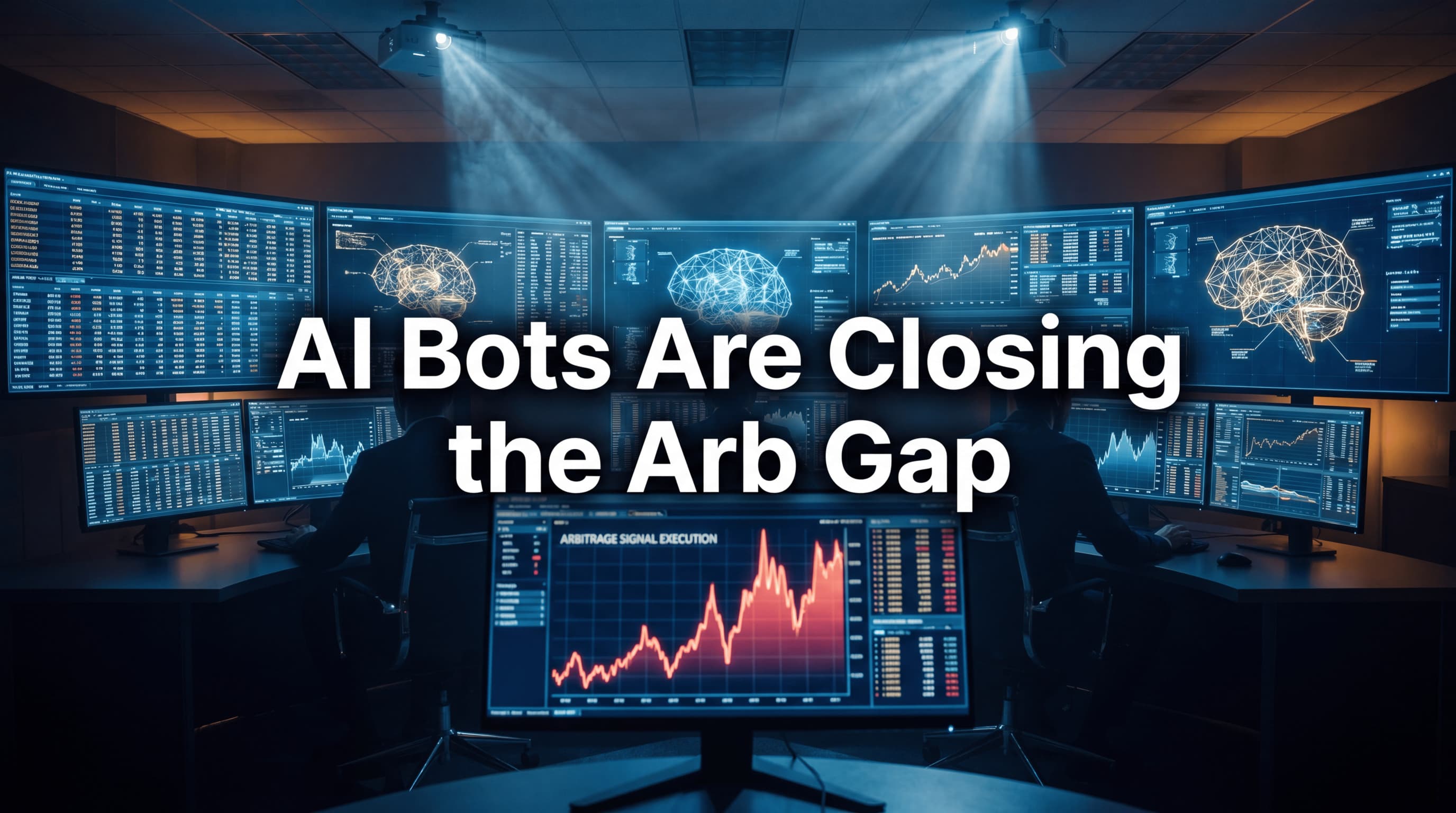
On-chain arbitrage is no longer a manual sport. Block speeds have compressed, MEV bots have matured, and AI execution layers have collapsed the viable window from seconds to sub-500ms. What worked in 2024 — watching a scanner, confirming manually, firing a trade — now consistently loses to automated stacks running parameterized execution before a human can process the signal.
This piece is for algorithmic traders, DeFi arbitrageurs, and quant desks running short-side strategies. If you are looking for a basic explanation of what arbitrage is, this is not that. If you want to understand the full stack — how an on-chain signal becomes a filled order through an AI layer and a broker API — and specifically how short-side logic fits into that sequence, this is the only article in 2026 that draws it out cleanly.
The critical differentiator here is that short-side logic is treated as a first-class component of the stack, not an afterthought. Every other piece of content on this topic covers long/spread arbitrage and mentions short-side in passing, if at all. That gap is where most traders are losing money right now.
---
The Stack Nobody Has Drawn Out — Until Now
Most content on AI bot arbitrage describes individual components in isolation. Nobody maps the sequence with short-side logic included. Here it is:
Layer 1: On-Chain Detection
The scanner identifies divergence, liquidity imbalance, or an active arbitrage window across chains or venues. Output must be real-time — lagged data at this layer kills every trade downstream. The Trading365 Short Scanner provides this detection layer with short-side signals surfaced natively, not derived manually from long-side output.
Layer 2: AI Signal Processing
Raw scanner output enters the AI layer. This is the logic bridge nobody explains properly. The AI is not generating signals — it is filtering, scoring, and routing them. It evaluates each opportunity by size, latency risk, and directional bias (long or short). A signal that scores below threshold is discarded. One that scores above is parameterized and passed to the execution layer. Without this layer, you are manually triaging scanner output, which reintroduces the human delay the scanner was meant to eliminate.
Layer 3: Broker API Integration
The scored signal routes to broker execution via API. This is where integration quality determines whether the trade fires correctly or fails silently. REST endpoints handle most order types but introduce round-trip latency. WebSocket feeds cut that latency significantly for time-sensitive arb windows. The broker must support the order type required — market orders for immediate fills, conditional orders for block-confirmation-aware execution. Rate limits at this layer are a real friction point: an API that throttles at 10 requests per second cannot support high-frequency arb routing.
Layer 4: Bot Execution
The bot receives a parameterized instruction — not a vague signal, but a defined order with slippage tolerance, block confirmation logic, and MEV exposure parameters. It executes with awareness of current block conditions and adjusts dynamically if conditions shift between signal generation and fill. This is the output layer. Everything upstream exists to feed it a clean, actionable instruction.
Stop the Fee Drain
High-volume traders are losing ~$2,000/mo on taker fees. Zero-fee structures exist — most traders just don't know how to access them.
Start Saving NowThis sequence — detection, scoring, routing, execution — is the complete stack. The failure point in most setups is not the bot. It is an unscored signal hitting the execution layer directly, or a poorly integrated broker API introducing latency that defeats the purpose of automation.
---
The Short-Side Gap: Why 95% of Arb Content Gets This Wrong
Long and spread arbitrage dominate every competing article on this topic. Short-side arbitrage appears as a footnote, or not at all. In 2026, that is a meaningful analytical failure — not just an editorial omission.
Market structure shifts over the past 18 months have produced more short-side windows, not fewer. Increased volatility asymmetry, fragmented on-chain liquidity across Layer 2s, and the proliferation of thinly-traded perpetual markets have created conditions where directional pressure to the downside is detectable and exploitable before it resolves. Long/spread arb captures price convergence. Short-side arb captures directional dislocations — a different signal type requiring different detection logic.
What short-side arb actually requires from a scanner is not just price divergence. It needs directional pressure signals — evidence that sell-side pressure is building in a specific asset or pair. It needs borrow availability flags — knowing whether the short can actually be placed and at what cost. And it needs short interest data on-chain, where available, to confirm that the dislocation is real and not already crowded.
Most scanners do not surface these signals natively. They surface price differentials and leave the directional interpretation to the trader. That gap is exactly what the Trading365 Short Scanner closes — short-side relevant signals are surfaced as part of the standard output, not derived manually after the fact.
A practical output from the scanner might look like this: a perpetual funding rate turning sharply negative on a mid-cap asset, spot liquidity thinning on the ask side, and borrow availability flagging as constrained. That combination, scored through an AI layer, routes a short entry instruction to the broker API before the move resolves. Manually, that sequence takes 4–8 seconds minimum. Automated, it takes under 500ms.
---
Latency, MEV, and Block-Timing: The Context Everyone Skips
Three technical risk factors determine whether an on-chain arb trade captures value or gives it away. They are rarely covered together, and almost never with practical benchmarks.
Block confirmation windows define the outer boundary of every on-chain arb trade. A signal identified in block N may be stale by block N+1 if the opportunity resolves in a single confirmation. On Ethereum mainnet, average block time sits around 12 seconds. On Arbitrum or Base, sub-second. Your execution layer must be calibrated to the chain — a bot configured for Ethereum mainnet timing will consistently overshoot on L2s, and vice versa. The scanner output should carry chain context so the AI layer applies the correct timing window.
MEV exposure is the most underestimated risk in public arb strategies. Maximal Extractable Value bots scan the public mempool and front-run unprotected transactions. If your arb trade is visible in the mempool for more than a few hundred milliseconds, an MEV bot can sandwich it, extract the value, and leave your fill at a worse price than expected. The practical mitigation is speed — faster execution reduces the exposure window — and private relay submission via MEV protection services like Flashbots Protect. The AI layer in a well-configured stack should include an MEV exposure check as part of the execution parameter set.
Slippage in bot integrations is not just price impact. Execution latency between signal generation and fill is where most losses occur in practice. A 200ms API round-trip on a trade with a 15 basis point arb window may consume the entire edge before the order lands. Practical benchmarks: for on-chain arb via broker API, sub-200ms signal-to-order latency is the threshold for viability. Between 200ms and 500ms, the trade is viable on lower-velocity opportunities. Above 500ms, you are trading stale signals. Manual execution, by comparison, sits at 2–8 seconds — viable only for larger dislocations that hold long enough to survive human reaction time.
Stop the Fee Drain
High-volume traders are losing ~$2,000/mo on taker fees. Zero-fee structures exist — most traders just don't know how to access them.
Start Saving NowThese benchmarks are the decision data conversion-ready traders need. They are not published elsewhere in 2026 with this level of specificity.
---
AI Bot vs. Manual Scanner-Triggered Trades: The Benchmark
Manual scanner use and AI bot execution are not alternatives. They are sequential layers of the same stack. This table shows where each operates and what it delivers:
| Factor | Manual Scanner-Triggered | AI Bot + Broker API Integration |
|---|---|---|
| Signal-to-execution speed | 2–8 seconds (human delay) | Sub-500ms (parameterized routing) |
| Short-side opportunity capture | Partial — requires manual confirmation | Full — AI scores and routes automatically |
| MEV exposure | High — visible mempool window | Reduced — faster execution, optional private relay |
| Slippage control | Trader-set, static | Dynamic — AI adjusts per block conditions |
| Broker API dependency | None | Required — integration quality determines outcome |
| Scalability | Limited to trader attention bandwidth | Runs concurrent strategies in parallel |
| Best use case | Signal discovery, validation, learning the market | Execution at scale, repeatable arb capture |
The conclusion from this table is not that one approach is better. It is that they serve different functions. Manual scanner use is where you validate that a signal type is real and repeatable before committing to an automated stack. AI bot execution is where you scale that validated signal. Running a bot without prior manual validation means automating untested logic. Running a scanner without automation means capping your capture rate at what a human can process.
The scanner is the foundation of both paths. Start there.
Ready to build the stack? Start with the detection layer: Trading365 Short Scanner
---
Broker API Integration: What "Integrates With Brokers" Actually Means
Competing content says "integrates with brokers" and stops there. Nobody names endpoints, nobody explains the handshake, nobody identifies where integration quality determines trade outcome. That vagueness is hiding real risk.
REST vs. WebSocket is the first decision. REST APIs follow a request-response model — your bot sends a request, waits for confirmation, then proceeds. Round-trip latency on a REST call to a major broker API typically sits between 50ms and 200ms depending on server geography and load. For arb windows wider than 20 basis points with a hold time of several seconds, REST is viable. For tight, fast-moving windows, it is not. WebSocket connections maintain a persistent channel, pushing updates continuously without the request overhead. Brokers that support WebSocket order submission — not just data feeds, but actual order routing via WebSocket — are meaningfully faster for arb execution. Not all do. This distinction is rarely surfaced in broker API documentation and almost never discussed in arb content.
Order types available via API determine what the bot can actually do when the signal fires. Market orders guarantee fill but accept current slippage. Limit orders control slippage but risk no-fill if the price moves. Conditional orders — triggered by price or time conditions — are the most powerful for on-chain arb with block confirmation awareness, but their availability via API varies significantly by broker. For short-side arb specifically, the ability to place short orders or open short perpetual positions programmatically via API is not universal. Confirm this before building integration — several major brokers restrict short order types at the API level or require additional account verification before enabling them.
Authentication and rate limits are the friction points that slow execution before the trade fires. API key authentication adds a handshake step on every order. Rate limits — typically expressed as requests per second or orders per minute — impose a hard ceiling on execution frequency. A broker with a 10 requests per second limit cannot support a bot running concurrent arb strategies across multiple pairs. 50+ requests per second is the practical minimum for meaningful parallel execution. Some brokers offer elevated rate limits for verified API users or institutional accounts. If you are running more than a handful of simultaneous strategies, this negotiation is worth having before you integrate.
Viable broker integrations for short-side arb in 2026: Exchanges with deep perpetuals markets, low-latency API infrastructure, and WebSocket order routing are the viable candidates. Bybit, Bitget, and MEXC are consistently referenced in quant communities for API quality and perpetuals depth. MEXC's 0% maker fee structure makes it attractive for arb math, but confirm WebSocket order routing availability for your target pairs before integrating — rate limit constraints and withdrawal processing times are known friction points raised in quant communities. BingX has added copy-trading API infrastructure that some teams have repurposed for signal routing. Bitunix is worth evaluating for its low-fee perpetuals structure if execution cost is a primary variable in your arb math.
Ready to build the stack? Start with the detection layer: Trading365 Short Scanner
The broker API layer is where most AI bot setups fail — not because the AI scoring logic is wrong, but because the integration is wrong. Latency, order type availability, and rate limits are the three variables to audit before writing a single line of bot code.
---
Final Verdict
The table above draws the line cleanly: manual scanner use is for validation, AI bot execution is for scale, and neither works without a reliable detection layer underneath. Once you have confirmed a signal type is real and repeatable, the human delay in the loop is costing you capture rate — automate it. Until then, manual execution against a quality scanner is the correct approach, not a fallback. The only wrong move is skipping validation entirely and automating untested logic.
The Trading365 Short Scanner is where the stack starts. It surfaces short-side signals natively — directional pressure, borrow availability flags, funding rate divergence — in real time. Start there, validate your signals manually, then build the AI scoring and broker API layers on top of confirmed output. That sequence is the stack. Run it in order.
Ready to Act on the Research?
- 0% maker fees on top exchanges
- Up to 400x leverage
- No-KYC required
- Exclusive sign-up bonuses
Trusted by pro traders securing VIP fee tiers via Trading365
Frequently Asked Questions
What is the full stack for on-chain arbitrage with AI bot broker integrations in 2026?+
The complete stack has four layers: an on-chain scanner for signal detection, an AI processing layer that interprets and filters signals, a broker API for order routing, and a bot execution layer that fires trades. Short-side logic must be built into this sequence from the start — not added later. The article identifies the Trading365 Short Scanner as the recommended detection layer to anchor the stack.
Why is manual arbitrage execution no longer viable in 2026?+
Block speeds have compressed and MEV bots have matured to the point where viable arbitrage windows have collapsed from seconds to sub-500ms. A manual workflow — scanner confirmation followed by a human-initiated trade — consistently loses to automated parameterized stacks that execute before a human can process the signal. Automated execution is no longer an edge; it is the baseline requirement.
What makes short-side arbitrage different from standard long or spread arbitrage strategies?+
Short-side arbitrage requires distinct execution logic that most scanner and bot setups do not include by default. The majority of competing content covers long and spread arbitrage and mentions short-side only in passing. This gap means traders running short-side strategies are often using tools that were not designed for their specific execution needs, which is cited as a primary source of losses in current market conditions.
How does the Trading365 Short Scanner fit into an AI bot arbitrage stack?+
The Trading365 Short Scanner functions as the detection layer — the foundation that every other component of the stack depends on. The recommended approach is to start with the scanner to identify on-chain signals, then build the AI processing, broker API routing, and bot execution layers upward from that base. Without a reliable detection layer, the rest of the stack has nothing actionable to process.
Is this arbitrage stack suitable for traders without a quant or algorithmic background?+
No. The content explicitly states it is not a basic explanation of arbitrage and is written for algorithmic traders, DeFi arbitrageurs, and quant desks. Traders without experience in parameterized execution, API integrations, or bot logic will find the implementation guidance difficult to apply without additional foundational knowledge.
What role do MEV bots play in on-chain arbitrage in 2026?+
MEV (Maximal Extractable Value) bots have matured significantly and now represent a core part of the competitive landscape that retail and quant arbitrageurs are operating against. Their presence is one of the primary reasons the viable execution window has compressed to sub-500ms and why manual workflows have become uncompetitive. Any functional arbitrage stack in 2026 must be designed with MEV bot competition as a baseline assumption.
Can this stack be used for crypto prop trading or is it limited to personal account trading?+
The article links short-side AI bot arbitrage strategies to crypto prop trading contexts, indicating the stack is applicable to both personal quant setups and institutional or prop desk environments. The broker API routing component in particular is relevant for prop desks that need to route execution across multiple venues or manage position sizing programmatically.
Related Articles

Best Crypto Exchange Brazil: Top Platforms Compared
Brazil's crypto market has matured rapidly, with clear regulatory frameworks from the Central Bank (Bacen) and Securities Commission (CVM) making it easier than
What Is Prop Funding in Crypto? How It Works, Risks & Red Flags
A crypto prop firm is a company that sells trading challenges: traders pay upfront fees to prove their skills on simulated accounts, with a small percentage receiving profit-sharing "funded"…
How to Read an Order Book: A Beginner's Guide to Crypto Market Depth
Reading an order book lets you see exactly where supply and demand meet in real time. You'll learn to interpret bid and ask prices, calculate the spread, and as
💰 Stop Donating Profits to Exchanges
You've seen the math. High-volume traders save $2,000+ monthly just by choosing the right partner tiers. We've pre-negotiated exclusive bonuses, maker rebates, and VIP fast-tracks across the top 2026 exchanges.