
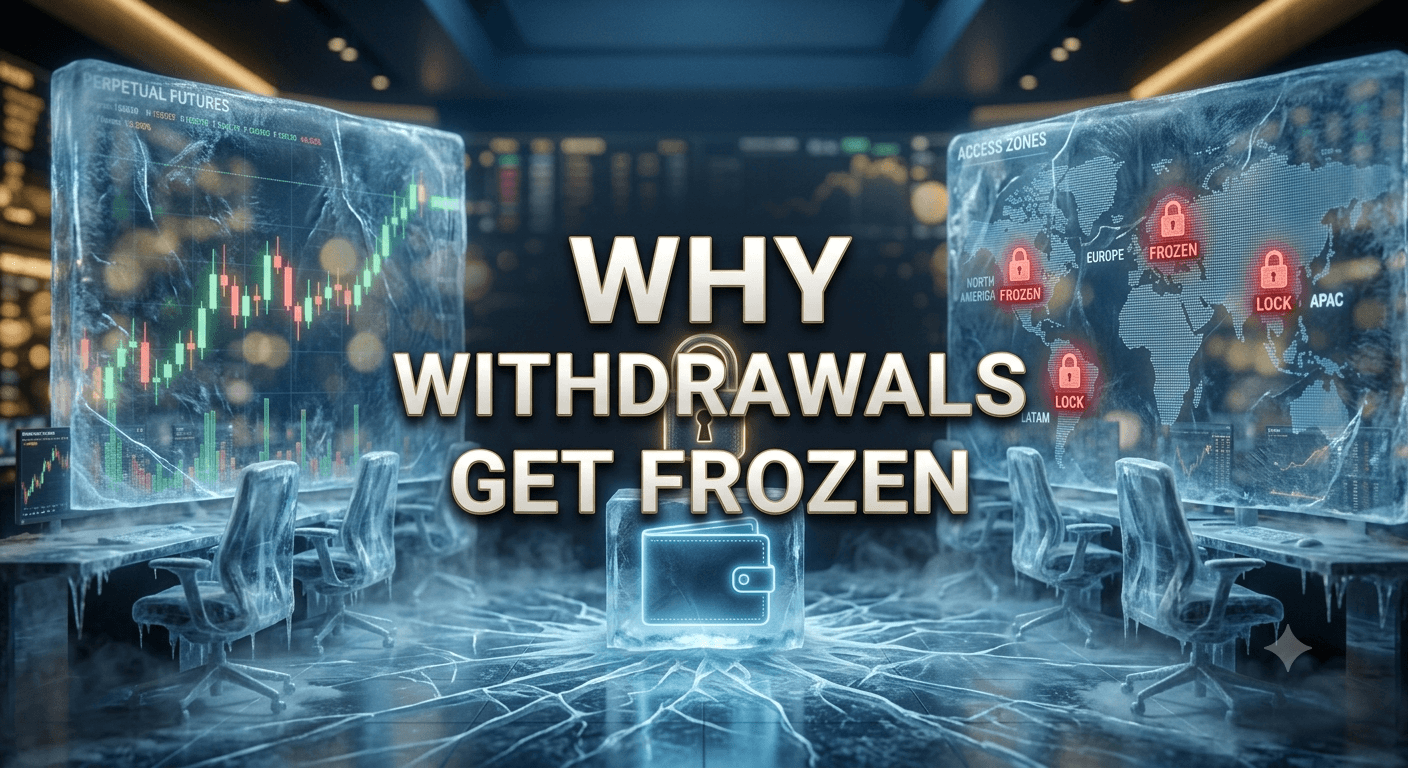
Pros
- Breaks down freezes into 4 clear categories so you know which one you're facing
- Gives realistic timelines: 24–72 hours for routine holds, days-to-weeks for compliance reviews
- Provides a concrete 5-minute triage checklist before contacting support
- Explains how to confirm scope using status pages, X, Reddit, and Downdetector
- Stresses documenting evidence with timestamps and case IDs early
Cons
- Some freezes (legal orders) can last indefinitely with no guaranteed resolution
- Insolvent or fraudulent exchange freezes may be permanent and unrecoverable
- Compliance/AML reviews can stretch for weeks with limited transparency
- Users have little direct control once a legal or regulatory order is placed
Claim Exclusive Trading Bonuses
- 0% maker fees on top exchanges
- Up to 400x leverage
- No-KYC required
- Exclusive sign-up bonuses
Trusted by pro traders securing VIP fee tiers via Trading365
Quick Answer
A frozen crypto withdrawal almost always falls into one of four categories: a security hold, a compliance/AML review, a legal or regulatory order, or exchange insolvency. The type determines everything — how long it lasts and what you should do next.
Most routine holds (security checks and standard verification requests) clear within 24–72 hours once you complete whatever the exchange asks for. Compliance reviews can take days to weeks. Legal orders may last indefinitely. And in the worst case — an insolvent or fraudulent exchange — the freeze can be permanent.
Your very first move is not to panic or spam the withdrawal button. It's to diagnose the freeze type by reading the official notification. Everything else follows from that diagnosis.
Quick Facts
| Field | Details |
|---|---|
| Freeze Types | Security hold, compliance/AML review, legal/regulatory order, exchange insolvency |
| Routine Hold Duration | 24–72 hours after completing requested steps |
| Compliance Review Duration | Days to weeks |
| Legal Order Duration | Potentially indefinite |
| Insolvency Outcome | Freeze can be permanent |
| First Step | Diagnose freeze type from official notification |
| Key Evidence | Timestamp, case/reference ID, screenshots |
| Scope Check Tools | Status page, exchange X account, subreddit, Downdetector |
Do This First (5-Minute Triage)
Before contacting anyone, spend five minutes gathering facts. This turns a stressful situation into a manageable process.
- Read the official notification. Check your email and in-app notifications for the exchange's stated reason. The wording usually tells you the freeze type ("we've detected unusual activity", "additional verification required", "temporary maintenance").
- Note the timestamp and any reference or case ID. You'll need this for every support conversation.
- Confirm the scope. Is this affecting only your account, or every user on the platform? Check the exchange's status page, its verified account on X, the relevant subreddit, and Downdetector. A platform-wide freeze is far more serious than an individual hold. See also How to Spot a Fake Crypto Exchange.
- Screenshot everything now. Capture the freeze message, your withdrawal history, your account balance and any error codes — before you start any support thread. Records made after the fact are weaker.
The 4 Types of Withdrawal Freezes (How to Tell Them Apart)
Learning to distinguish these four is the single most useful skill here. Each has a different trigger, timeline and level of danger.
Security hold. Triggered by something that looks risky: a login from a new device, a recent password or 2FA change, an unusually large withdrawal, or a suspicious login attempt. Many exchanges automatically lock withdrawals for a set period (often 24–48 hours) after a security-sensitive change. These are the most common and least worrying.
Compliance / AML review. Triggered by anti-money-laundering rules. The exchange may need to complete your KYC, screen you against sanctions lists, or ask for a source-of-funds explanation on a large or unusual transfer. These are legitimate but slower — days to a few weeks — and they resolve once you supply the documents requested.
Legal / regulatory order. Triggered by a court order, a law enforcement request, or your account being tied to a sanctioned or restricted jurisdiction. The exchange has no choice and often can't tell you much. These can last indefinitely and may require legal advice.
Exchange insolvency or scam. The danger zone. Signs include a whole-platform freeze, vague "maintenance" or "system upgrade" excuses that never end, missed payouts and unresponsive support. This is where funds can actually be lost — and no-KYC platforms carry higher freeze and exit-scam risk.
Here's a quick-reference guide:
| Freeze type | Typical trigger | Typical timeline | Severity |
|---|---|---|---|
| Security hold | New device, password/2FA change, large withdrawal | 24–48 hours | Low |
| Compliance / AML | KYC gap, sanctions screening, source-of-funds check | Days to weeks | Medium |
| Legal / regulatory | Court order, law enforcement, restricted jurisdiction | Indefinite | High |
| Insolvency / scam | Platform-wide freeze, "maintenance", missed payouts | Often permanent | Critical |
Step-by-Step: What to Do
- Match your notification to a freeze type. Use the descriptions above. This decides your whole strategy — a 48-hour security hold needs patience; a platform-wide "maintenance" freeze needs urgency.
- Complete any pending verification. This is the single most common fix. If the exchange is asking for ID, a selfie, an address proof or a source-of-funds statement, provide it accurately and promptly. Incomplete KYC is behind a huge share of "stuck" withdrawals.
- Contact support with a clear, factual message. Include your case ID and the specifics. Use one of the templates below rather than an emotional paragraph — support agents respond faster to structured requests.
- Set a follow-up clock. Note the platform's stated response time (SLA). If it says 48 hours and you hear nothing, that's your trigger to escalate — not to open ten new tickets.
- Escalate through official channels. Ask for tier-2 support, use the dedicated compliance email if one exists, and reply through verified social handles only. Never trust a "support agent" who DMs you first.
- Document every interaction. Save each reply with its timestamp. A clean paper trail matters if you later file a regulatory complaint or a bankruptcy claim.
- Assess for red flags. Run through the checklist below to decide whether this is a routine hold or something closer to exit-scam territory. That judgment changes your next move entirely.
Stop the Fee Drain
High-volume traders are losing ~$2,000/mo on taker fees. Zero-fee structures exist — most traders just don't know how to access them.
Start Saving NowSupport Script Templates
Keep messages short, specific and unemotional. Copy and adapt these.
Routine security or AML hold:
Subject: Withdrawal hold — Case ID [XXXX] Hello, my withdrawal of [amount/asset] initiated on [date/time UTC] is currently on hold. I understand this may be a routine security or compliance review. Please confirm the reason and list any documents or actions you need from me to release it. My account is fully verified. Reference/transaction ID: [XXXX]. Thank you.
Escalation when the SLA is breached:
Subject: Escalation — unresolved withdrawal hold, Case ID [XXXX] Hello, I opened case [XXXX] on [date] regarding a frozen withdrawal. Your stated response time is [X hours], which has now passed without resolution. Please escalate this to a senior/tier-2 agent and provide a specific timeline. I have attached my previous correspondence and screenshots. Thank you.
What to attach: your case ID, the transaction hash (if one was generated), a screenshot of the freeze notification, and confirmation that your KYC is complete. Supplying these upfront removes the most common reasons for delay.
Red-Flag Checklist: When Funds May Be Gone
If several of these are true at once, treat it as a potential insolvency or scam rather than a routine hold:
- A platform-wide freeze justified only with vague "maintenance" or "upgrade" language that keeps getting extended.
- Support silence or bot-only replies — no human ever engages, and tickets are auto-closed.
- Withdrawals disabled while deposits stay open. This is a classic warning sign; a healthy exchange rarely keeps taking money it won't let out.
- A demand for a new "unlock fee", "tax" or "deposit" before your funds are released. This is always a scam. No legitimate exchange asks you to pay to access your own balance.
- Insolvency rumors, a halted or cancelled audit, or missing/outdated proof-of-reserves.
One or two of these might be a coincidence. Three or more together means act fast and assume the worst while you still have options.
Escalation & Recovery Options
If normal support fails, you have several external routes. The right ones depend on how you funded the account and whether fraud is suspected.
- File a complaint with the exchange's regulator. Find which authority licenses the platform — for example the FCA, SEC, MAS or a local equivalent — and submit a formal complaint with your documentation. Regulated exchanges take these seriously.
- Request a card chargeback if you funded the account by card recently. Your bank or card issuer may reverse the transaction, though time limits apply, so move quickly.
- Report to law enforcement. For suspected fraud, contact your national cybercrime or fraud unit and file a report. This creates an official record and can feed into larger investigations.
- Follow the bankruptcy or class-action process. When an exchange collapses, users typically become creditors and file claims through a court-supervised process. It's slow and recovery is often partial, but registering your claim is essential.
- Trace the funds on-chain. If you have the transaction hash, blockchain explorers and tracing tools can show where assets moved. This won't recover funds by itself, but it supports investigations and complaints.
Stop the Fee Drain
High-volume traders are losing ~$2,000/mo on taker fees. Zero-fee structures exist — most traders just don't know how to access them.
Start Saving NowTips & Common Mistakes
- Don't repeatedly retry the withdrawal. Each attempt can look like suspicious activity and extend a security hold rather than shorten it.
- Never pay a fee to "unlock" funds. There is no legitimate scenario where you must pay to access your own money. Any such demand is a scam, full stop.
- Move funds to self-custody once released. If a freeze scared you, that's a signal to hold long-term balances in your own wallet rather than on an exchange.
- Prefer exchanges with published proof-of-reserves and a clearly documented freeze and dispute policy. Transparency now saves pain later.
- Keep your KYC current. Expired ID documents silently trigger holds on many platforms — update them before you need to withdraw.
Conclusion
A frozen withdrawal feels alarming, but the response is straightforward once you know the type. Diagnose first: a security hold clears with time, a compliance review clears with documents, a legal order needs advice, and an insolvency needs fast escalation and realistic expectations.
Act quickly on documentation and escalation, use structured support messages, and learn to recognise the red flags that separate a routine delay from a platform in trouble. The long-term fix is the simplest one of all — keep only what you're actively trading on an exchange, and hold the rest in self-custody where no one can freeze it.
Ready to Act on the Research?
- 0% maker fees on top exchanges
- Up to 400x leverage
- No-KYC required
- Exclusive sign-up bonuses
Trusted by pro traders securing VIP fee tiers via Trading365
Frequently Asked Questions
How long does a frozen crypto withdrawal usually take to clear?+
Most routine security checks and standard verification requests clear within 24–72 hours once you complete what the exchange asks. Compliance and AML reviews can take days to weeks. Legal orders may last indefinitely, and insolvency-related freezes can be permanent.
Why did my crypto exchange freeze my withdrawal?+
A freeze almost always falls into one of four categories: a security hold, a compliance/AML review, a legal or regulatory order, or exchange insolvency. Read the official notification carefully — the wording usually reveals the type, such as 'unusual activity detected' or 'additional verification required.'
What should I do first when my withdrawal is frozen?+
Don't panic or repeatedly click the withdrawal button. Spend five minutes reading the official notification, noting the timestamp and case ID, confirming whether the freeze affects only you or the whole platform, and screenshotting everything before opening a support ticket.
How can I tell if a withdrawal freeze affects only my account or everyone?+
Check the exchange's status page, its verified account on X, the relevant subreddit, and Downdetector. An individual hold is usually a security or verification issue, while a platform-wide freeze is far more serious and may signal technical failure or insolvency.
Can a frozen crypto withdrawal be permanent?+
Yes. In the worst cases — an insolvent or fraudulent exchange — the freeze can be permanent and funds may be unrecoverable. Legal or regulatory orders can also last indefinitely, so identifying the freeze type early is critical.
Why is it important to screenshot everything before contacting support?+
Records created before you open a support thread are stronger than ones made afterward. Capture the freeze message, withdrawal history, account balance, and any error codes so you have timestamped evidence for every support conversation or potential dispute.
What's the difference between a compliance review and a legal order freeze?+
A compliance or AML review is initiated by the exchange to verify your activity and typically resolves in days to weeks. A legal or regulatory order comes from an external authority, gives the exchange little discretion, and may last indefinitely until the matter is resolved.
Related Articles
What Is Prop Funding in Crypto? How It Works, Risks & Red Flags
A crypto prop firm is a company that sells trading challenges: traders pay upfront fees to prove their skills on simulated accounts, with a small percentage receiving profit-sharing "funded"…
How to Read an Order Book: A Beginner's Guide to Crypto Market Depth
Reading an order book lets you see exactly where supply and demand meet in real time. You'll learn to interpret bid and ask prices, calculate the spread, and as

Best Crypto Exchange for Day Trading: Top Platforms Ranked for Speed, Fees & Liquidity
Day trading crypto demands tight spreads, fast execution, and reliable uptime—small inefficiencies compound into significant costs across hundreds of trades. Th
💰 Stop Donating Profits to Exchanges
You've seen the math. High-volume traders save $2,000+ monthly just by choosing the right partner tiers. We've pre-negotiated exclusive bonuses, maker rebates, and VIP fast-tracks across the top 2026 exchanges.