
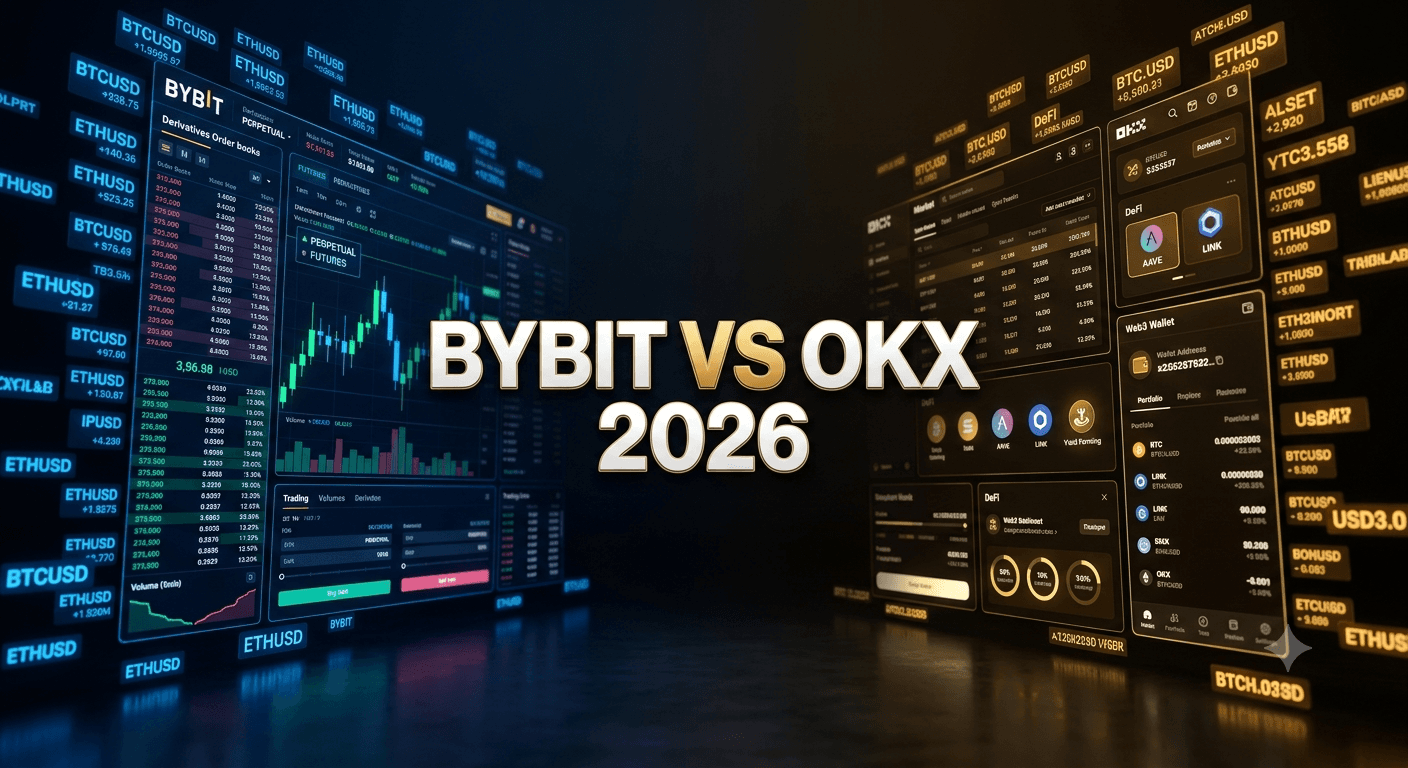
Pros
- Bybit offers perpetuals-first design with consistently deep BTC/ETH order books and a reliable matching engine under volatility
- Bybit's Unified Trading Account lets spot holdings back derivatives margin
- OKX covers a broader token selection with large-scale spot, options, margin, and structured earn products
- OKX includes an integrated Web3/DeFi wallet and strong on-chain tools in one account
- OKX fee tiers and API depth reward high-volume and pro traders
- Bybit's interface is slightly less cluttered, easing the learning curve for beginners
Cons
- Availability is heavily country-dependent — either exchange may be unusable in your jurisdiction
- OKX's wide feature set adds friction and complexity for beginners early on
- Bybit remains derivatives-centric, so spot and multi-asset traders get less coverage than on OKX
- Both operate under uneven regulatory licensing, remaining unavailable in some markets
Claim Exclusive Trading Bonuses
- 0% maker fees on top exchanges
- Up to 400x leverage
- No-KYC required
- Exclusive sign-up bonuses
Trusted by pro traders securing VIP fee tiers via Trading365
Quick Verdict: Which Exchange for Which Trader
If you live and breathe perpetual futures and want the deepest, cleanest order books with a fast liquidation engine, Bybit is usually the tighter fit. If you want a single account that handles serious spot trading, a large token selection, on-chain tools, and a built-in Web3 wallet alongside derivatives, OKX tends to win.
- Derivatives-focused traders → Bybit for its perpetuals-first design and consistently deep BTC/ETH order books.
- Spot and multi-asset traders → OKX for broader token coverage, staking/earn products, and an integrated DeFi wallet.
- Beginners → Bybit's interface is slightly less cluttered; OKX offers more, but the extra features add friction early on.
- Pro/high-volume traders → OKX's fee tiers and API depth reward volume, though both are competitive.
One important flag before you read further: whether either exchange is usable at all depends heavily on your country. See the availability section — for some readers this decides the question before fees ever matter.
Quick Facts
| Field | Details |
|---|---|
| Bybit Operator | Bybit Fintech |
| Bybit Focus | Perpetual & futures trading |
| OKX Focus | All-in-one spot, derivatives, options, earn |
| Account Type | Bybit Unified Trading Account |
| Web3 Wallet | Both offer integrated wallets (OKX stronger) |
| Best for Derivatives | Bybit |
| Best for Spot/Multi-Asset | OKX |
| Availability | Varies by country (both) |
What Each Exchange Is
Bybit started as a derivatives specialist and that heritage still defines it in 2026. Its core strength is perpetual and futures trading: deep liquidity on major pairs, a reliable matching engine under volatility, and a Unified Trading Account that lets spot holdings back derivatives margin. It has since expanded into spot, copy trading, earn products, and a Web3 wallet, but perpetuals remain the centre of gravity. Bybit is operated by Bybit Fintech and has pursued licensing in select jurisdictions while remaining unavailable in others.
Blocked on this exchange?
Trading365 users are pre-approved for Bybit and WEEX — with local regional workarounds and high-limit withdrawals. No extra steps required.
OKX is a broader, all-in-one platform. It offers large-scale spot markets, perpetuals and futures, options, margin, structured earn products, and one of the more mature self-custody Web3 wallets integrated directly into the app. Its standout is breadth: more listed assets, more on-chain functionality, and strong options liquidity relative to most competitors. OKX is one of the larger global exchanges by volume and, following its 2024 DOJ settlement, has expanded regulated operations in some regions while restricting or exiting others.
Head-to-Head Comparison Table
Fees below reflect standard entry-tier rates for retail accounts. Both exchanges use volume-based tiers and native-token discounts, so your real rate can be lower.
| Dimension | Bybit | OKX |
|---|---|---|
| Spot maker / taker (entry tier) | ~0.10% / 0.10% | ~0.08% / 0.10% (lower entry maker) |
| Derivatives maker / taker | ~0.02% / 0.055% | ~0.02% / 0.05% |
| Typical funding rate range | Small positive/negative, resets every 8h | Small positive/negative, resets every 8h |
| Max leverage (BTC perps) | Up to 100x | Up to 100x |
| Supported assets | ~600+ tokens | ~700+ tokens |
| Trading pairs | ~600+, derivatives-heavy | ~700+, broader spot + options depth |
| Withdrawal speed (observed) | Fast, minutes on major chains | Fast, minutes on major chains |
| Withdrawal fees | Network-based, standard | Network-based, standard |
| Slippage on liquid pairs | Very low | Very low |
| Sub-accounts | Supported | Supported (more granular) |
| Fiat on/off-ramps | Card, P2P, third-party | Card, P2P, broader coverage |
| Regional availability | Restricted in several markets | Restricted in several markets |
Treat exact numbers as approximate. Fee schedules, leverage caps and available products change, and both platforms adjust caps during high volatility. Always confirm current rates in-app before trading.
Key Differences Explained
Fees in practice. The headline gap is small. On a $10,000 spot buy, the difference between 0.08% and 0.10% is $2 — real but minor. Where fees actually bite is in high-frequency derivatives trading: at scale, the taker rate and your volume tier matter far more than the spot spread. OKX's entry-tier spot maker is slightly cheaper (~0.08% vs ~0.10%) largely because its default tiering rewards volume sooner. Both exchanges cut fees meaningfully as you climb tiers or hold their native token, so a heavy trader should model their own volume rather than judge on entry-tier numbers.
Derivatives depth. This is where the two diverge in feel. Bybit's perpetuals were built first and its liquidation engine and funding mechanics are battle-tested under stress. Top BTC perp books typically quote a spread around $0.10–$0.50 with several million dollars resting within the first few ticks on both venues. Funding on both settles roughly every eight hours and simply transfers between longs and shorts to keep the perp price tethered to spot — neither exchange is unusual here. OKX adds a genuinely strong options market and more granular margin modes, so if you trade options or want fine-grained portfolio margin, OKX pulls ahead. For plain perpetuals on BTC and ETH, both are excellent and the choice comes down to interface preference.
Execution quality. On liquid pairs — BTC, ETH, major perps — slippage is negligible on both during normal conditions. The difference shows on thinner altcoin markets: OKX's wider listing means you'll find more small-cap tokens, but thinner books mean wider spreads and worse fills there. Bybit lists fewer obscure tokens but concentrates liquidity. If you trade long-tail assets, check the specific book depth before assuming either is "deep."
Withdrawal and liquidity. In hands-on use, both process crypto withdrawals within minutes on major networks once security checks clear, and fees track the underlying network cost. First-time or large withdrawals may trigger additional verification on either platform — that's normal, not a red flag.
Platform UX. Bybit's app feels more focused: fewer top-level menus, faster to reach a perpetual order ticket. OKX packs in more — Web3 wallet, DeFi access, earn, options, trading bots — which is powerful for advanced users but presents more to learn on day one. A beginner will feel oriented faster on Bybit; a power user will appreciate having everything under one OKX login.
Regulatory & Availability in 2026
This section matters more than fees for many readers. Both exchanges block users in restricted markets, and access rules change. Security history matters too: Bybit suffered a roughly $1.5B hack in 2025 but honoured customer balances and continued operating, while OKX's 2024 DOJ settlement reshaped its compliance posture — both are worth weighing alongside availability.
- United States: Neither Bybit nor OKX offers its full global platform to US retail users in the same way it serves other regions. US residents face significant restrictions, and attempting to bypass geoblocks violates terms of service. Treat both as effectively unavailable for standard US retail use unless you confirm a specific compliant offering.
- United Kingdom: Both operate under the UK's financial promotion rules, which limit how crypto products can be marketed and which products retail users can access. Expect restrictions on certain high-leverage derivatives.
- European Union: Under the MiCA framework now in force, exchanges must meet registration and disclosure requirements to serve EU users. Availability and specific products vary by member state depending on each exchange's registration status.
- Canada: Access has been constrained for several global exchanges due to provincial registration requirements; confirm current status before assuming either is available.
Stop the Fee Drain
High-volume traders are losing ~$2,000/mo on taker fees. Zero-fee structures exist — most traders just don't know how to access them.
Start Saving NowKYC is mandatory on both for meaningful use. Basic verification unlocks core trading; higher tiers raise withdrawal limits and enable fiat ramps. Unverified or low-tier accounts face tight limits, so complete verification early if you intend to trade seriously.
Because these rules shift, do not rely on this snapshot alone — open each exchange's site from your own country and check whether registration is even permitted before comparing anything else.
Which to Choose, and When
- Choose Bybit if you are primarily a perpetuals trader who wants a focused, fast interface, deep liquidity on major pairs, and a proven liquidation engine — and you don't need a sprawling feature set.
- Choose OKX if you want one account covering deep spot markets, a wide token selection, options, structured earn products, and an integrated Web3 wallet — and you're comfortable navigating a busier platform.
- Skip both if neither is legally available or fully functional in your country. No fee advantage is worth trading on a platform you cannot properly access, verify on, or withdraw from — and using a VPN to bypass geoblocks risks locked funds and account closure.
Conclusion
The decisive difference is scope, not quality — both are strong, well-established exchanges. Above all, check what's available and compliant where you live before comparing anything else and is willing to trade simplicity for range. Pick based on how you actually trade and, above all, on what's available and compliant where you live. Confirm current fees, leverage caps, and regional access in-app before committing — those details move, and your own country's rules are the first filter that should decide the question.
Ready to Act on the Research?
- 0% maker fees on top exchanges
- Up to 400x leverage
- No-KYC required
- Exclusive sign-up bonuses
Trusted by pro traders securing VIP fee tiers via Trading365
Frequently Asked Questions
Is Bybit or OKX better for derivatives trading?+
Bybit is usually the tighter fit for perpetual futures traders thanks to its perpetuals-first design and consistently deep BTC/ETH order books. Its matching engine holds up reliably under volatility. OKX is competitive but built as a broader platform rather than a derivatives specialist.
Which exchange is better for spot and multi-asset trading?+
OKX tends to win for spot and multi-asset traders due to broader token coverage, staking and earn products, and an integrated DeFi wallet. It functions as an all-in-one platform covering spot, futures, options, and margin in a single account.
Is Bybit or OKX easier for beginners?+
Bybit's interface is slightly less cluttered, which makes it easier to navigate when starting out. OKX offers more features, but that extra functionality can add friction and complexity early in your trading journey.
What is Bybit's Unified Trading Account?+
Bybit's Unified Trading Account lets your spot holdings back your derivatives margin from a single account. This lets traders use one balance across spot and perpetual positions rather than managing separate wallets.
Are Bybit and OKX available in my country?+
Availability depends heavily on your jurisdiction, and for some users this decides the question before fees even matter. Both exchanges have pursued licensing in select regions while remaining unavailable in others. Check each exchange's availability for your specific country before signing up.
Which exchange is better for high-volume pro traders?+
OKX's fee tiers and API depth reward volume, making it attractive to pro and high-volume traders. That said, both exchanges are competitive on fees and API access, so the choice may come down to which markets and tools you rely on most.
Does OKX have a built-in Web3 wallet?+
Yes, OKX includes an integrated Web3/DeFi wallet alongside its trading products, giving it strong on-chain capabilities. Bybit has also expanded into a Web3 wallet, but OKX's on-chain tooling is generally more developed.
Related Articles
Bitget vs Bybit: Which Crypto Exchange Fits Your Trading Style in 2026?
Bitget and Bybit serve different trader profiles despite looking similar on the surface. Choose Bitget if you want to copy experienced traders or prioritize low

Kraken vs Coinbase: Which Crypto Exchange Fits Your Needs in 2026?
Kraken is a US-founded cryptocurrency exchange launched in 2011 by Jesse Powell. It operates globally with a particularly strong presence in Europe, and has bui
WEEX vs MEXC: Which Crypto Exchange Fits Your Trading Style in 2026
Compare WEEX and MEXC fees, leverage, copy trading, and safety. See which crypto exchange wins for spot trading, futures, and altcoins in 2026.
💰 Stop Donating Profits to Exchanges
You've seen the math. High-volume traders save $2,000+ monthly just by choosing the right partner tiers. We've pre-negotiated exclusive bonuses, maker rebates, and VIP fast-tracks across the top 2026 exchanges.